Standing Too Close
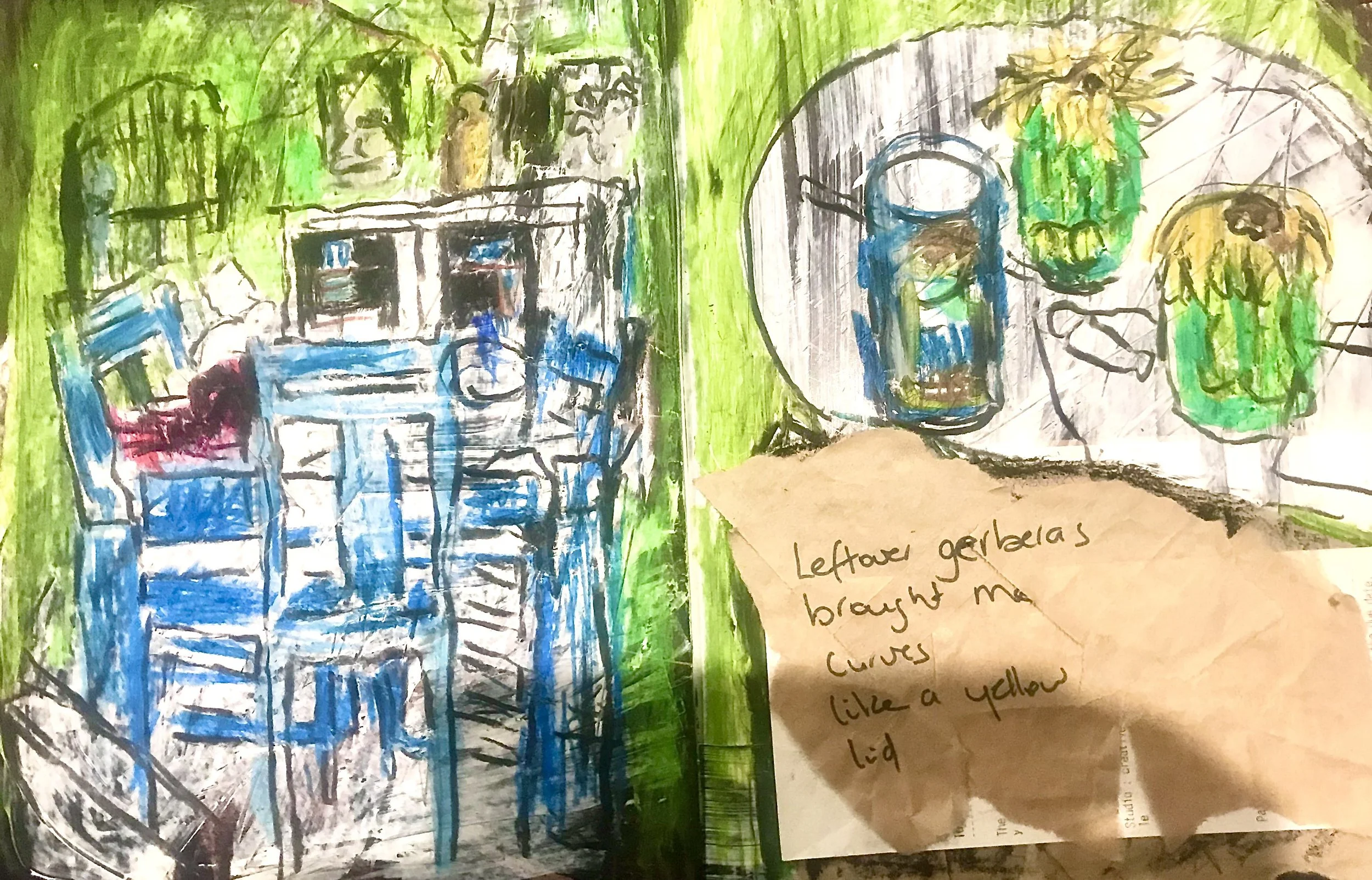
Sketchbook page. Pastel and mixed media. 2020.
On the left, a densely worked interior: chairs, a table and a window layered in blue and green pastel. On the right, a study of leftover gerberas in green glass, a till receipt, and a line of text on a scrap of brown paper. Some of these things I would usually edit out.
When I first took the photograph, I saw only bad light and an imperfect record. Something I would not need again.
I no longer have the original work.
Revisiting the image years later, I noticed something else. My shadow falls across the lower right-hand corner. My outline interrupts the surface. I had been standing too close. On the paper, in my handwriting: Leftover gerberas brought me curves like a yellow lid — a note written while making. Some words catch the light. Others disappear beneath my shadow.
I had learned to be ruthless. To cut decisively. Over time I began to mistake abandonment for discernment, as though erasing early proved I had judged properly, rather than losing patience with the slow work of becoming.
My work begins with jars, tables, half-finished thoughts — arrangements that do not announce themselves as important. I start with what is already around me at home. I am learning that success may not be the finished thing I once believed it to be. It may be the ability to stay. To remain attentive. To keep working with something that has not yet found its form.
I have spent years learning how to disappear from my own work. Here I could not. The shadow will not lift out; the record and the interruption are the same photograph.
I no longer see a failure. I see the layered surface, the line, the handwritten note, and someone standing too close — deciding too quickly what deserved to survive.
The critic is always there, but I am learning to recognise her.