A Room Made of Glass
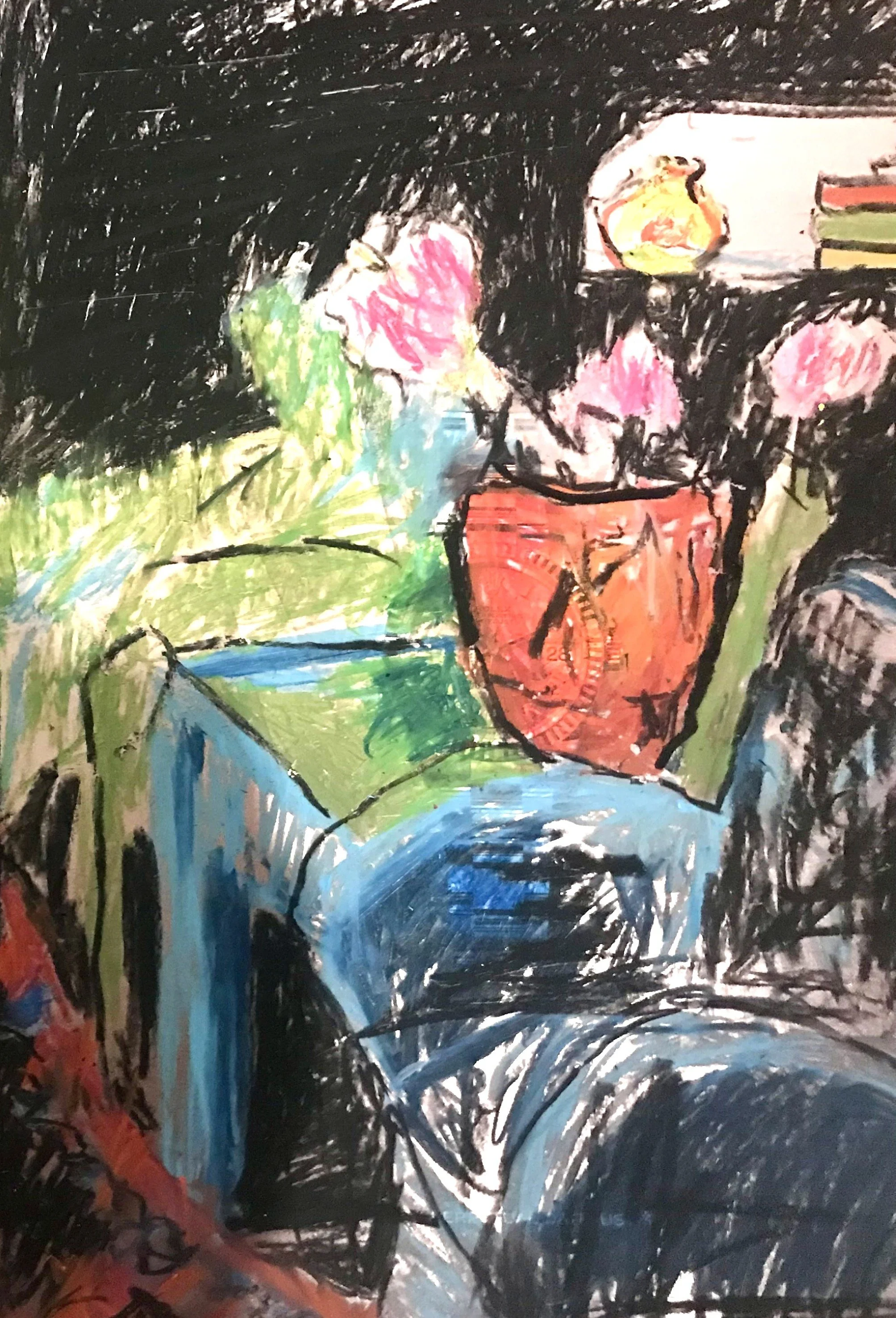
Corner of my lounge. Pastel on paper. 2020.
Growing up, I shared a room with one of my sisters. Two single beds, a view over the driveway. We shared everything in that room until we didn't. After a falling out, strict borders were drawn: my side, her side. We were near-mirror images of each other, with minor differences that mattered at the time. She had red hair; mine was brown. I was exactly one year and eight days older.
In that room stood a piece of furniture we called a duchess. It had one large central mirror and two smaller hinged mirrors that folded inwards. Today I recognise their practical purpose — angled glass offers a side view of the face, so you can check how hair and light are behaving. Then, they were something else entirely. If I angled them just right, the reflections multiplied. Glass rooms opened into other glass rooms. Versions of myself receded into the distance, smaller and smaller, endlessly repeated.
Mirrors are objects of fascination and unease. They appear simple, and they are not. Once reserved for the wealthy, they are now ordinary, and they still hold us. Mirror-making was a toxic and perilous trade. It involved handling mercury — a hazardous process resulting in an object so intimate, so domestic, that its existence feels almost miraculous. Glass has accompanied our understanding of the self for centuries. Without it there would be no mirror, no lens, no way to capture a moment. When glassmakers learned to coat glass with metal, it altered how we saw ourselves.
In Jan van Eyck's Arnolfini Portrait (1434), a convex mirror shows rooms within rooms, witnesses within scenes — a world doubled and contained. For centuries, male artists portrayed women with mirrors, absorbed in their reflections, arranged as symbols of beauty, vanity, or moral warning. Those images tell us more about the painter than the subject.
Then women turned the mirror on themselves. Barred from life drawing classes, forbidden to study the nude body, excluded from professional training, they found in the mirror a workaround: a willing and ever-present model. The instrument of their objectification became the instrument of their authorship.
Much of my own practice is self-portraiture. Sometimes literally. More often obliquely — a figure imagined, myself as a creature, a character drawn from memory. I have come to believe that even a drawing of the corner of my lounge is a self-portrait: it reveals my attention, my habits, what I choose to frame and what I leave out.
And what I most often leave out is the face.
In Looking Out at the View I took childhood photographs and redacted the faces, setting them against written self-portraits assumed in other people's voices. In the collages, a woman's head is replaced by a gemstone, an apple, a fold of cloud. I have spent years making self-portraits that decline the one thing the mirror is for.
Perhaps that is the point. The mirror does not lie, but it tells the truth without context. What it returns is shaped by time, by experience, and by everything we have already absorbed about how a woman should look back. To cover the face is not to hide. It is to refuse a bad question.
And the first mirror in that room was never the duchess. It was her — a near-identical face, one year and eight days behind mine, red where I was brown, on the other side of a line drawn down the middle of the floor. Everything I have since said about reflection was already happening between the beds: the resemblance, the border, the truth arriving without context.
To work with the mirror is to stand in full view of oneself and of others, occupying a room made of glass.