A Room Made of Glass
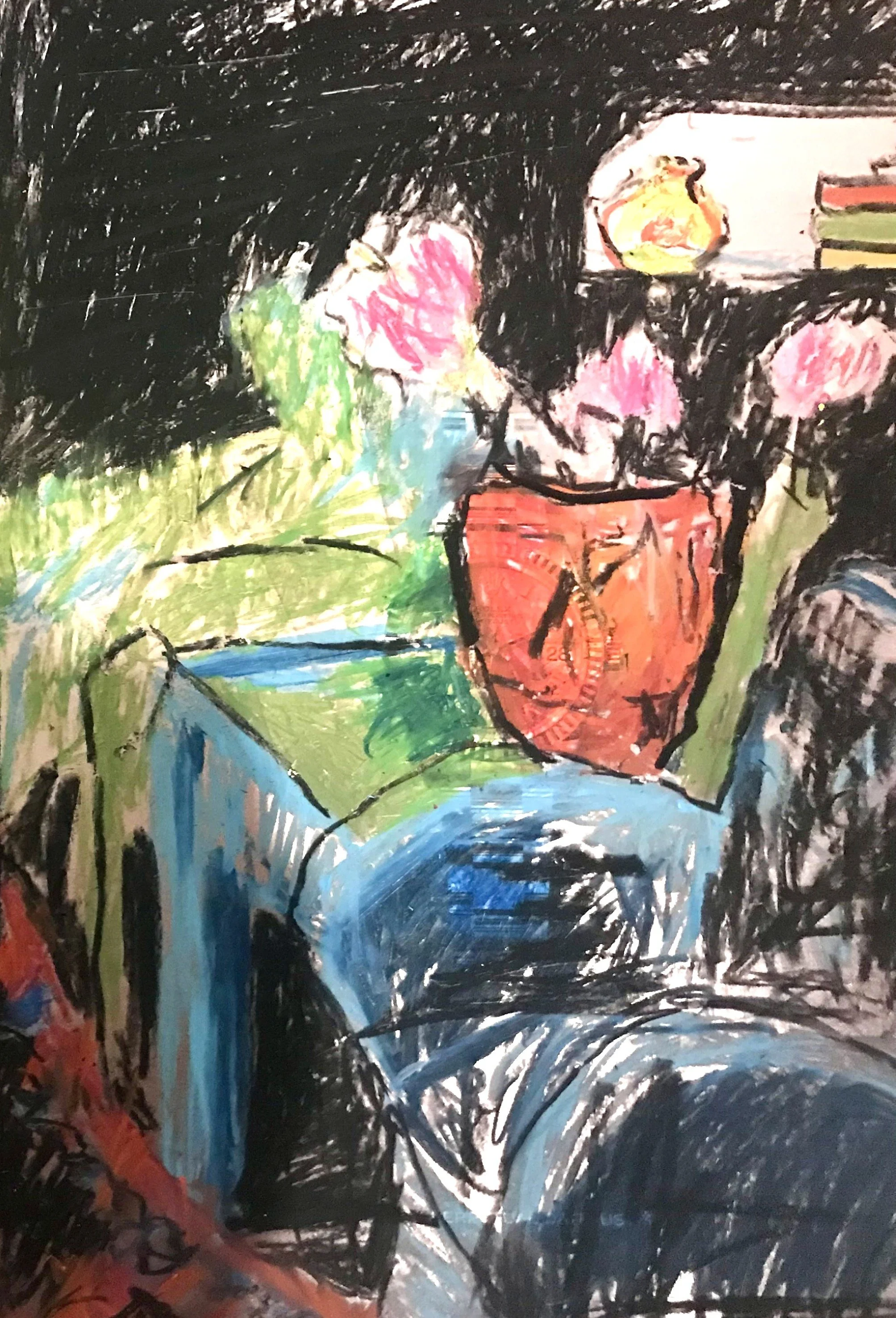
Corner of my lounge
Growing up, I shared a room with one of my sisters. Two single beds, a view over the driveway. We shared everything in that room until we didn’t. After a falling out, strict borders were drawn. There was my side and her side. We were near-mirror images of each other, with minor differences that mattered at the time. She had red hair, whereas mine was brown. I was exactly one year and eight days older.
In that room stood a piece of furniture we called a duchess. It had one large central mirror and two smaller hinged mirrors that folded inwards. Today, I recognise their practical purpose. Angled mirrors offered a side view of the face, allowing you to check how hair and light are behaving. Then, they were something else entirely. If I angled them just right, the reflections multiplied. Glass rooms opened into other glass rooms. Versions of myself receded into the distance, smaller and smaller, endlessly repeated.
Mirrors are objects of fascination and unease. They appear simple, yet they’re not. Once reserved for the wealthy, they are now ordinary, yet they still hold us. There is something magical about them, not only in what they show but in how they are made. Mirror-making was a toxic and perilous occupation. It involved the handling of mercury, a hazardous process that resulted in an object so intimate, so domestic, that its existence feels almost miraculous. Glass has accompanied our understanding of the self for centuries. Without it, there would be no mirror, no lens, no way to capture the moment. When glassmakers learned to coat glass with metal to create a reflective surface, it altered how we saw ourselves.
In Jan van Eyck’s Arnolfini Portrait (1434), a convex mirror shows rooms within rooms, witnesses within scenes — a world doubled and contained. For centuries, male artists portrayed women with mirrors, absorbed in their reflections, arranged as symbols of beauty, vanity, or moral warning. These images often tell us more about the painter than the subject, and about the social values of the time.
What is significant is that women eventually turned the mirror on themselves, taking control of their own image. For women artists, mirrors offered something else again. Barred from life drawing classes and forbidden from studying the nude body, women were excluded from professional training. The mirror became a workaround to a willing and ever-present model.
Today, we are saturated with selfies and constant visual self-reference. But there is a difference between the photo captured on a phone and the slow (or not-so-slow) inquiry of a self-portrait.
Much of my own practice consists of self-portraiture. At times, this is literal. At others, it is an oblique reference — a figure imagined, myself as a creature, or a character drawn from memory or narrative. I have come to believe that even a drawing of the corner of my lounge is a self-portrait revealing my attention, my habits, what I choose to frame, and what I leave out.
Why do we continue to turn the mirror on ourselves? And what can a self-portrait achieve that a selfie cannot? Is a self-portrait a way of holding a question? To make one, you must first be able to see yourself, and recognition is never straightforward. The mirror does not lie, but it tells the truth without context. What we see reflected is shaped by time, by experience, and by the “gaze” of what we have already absorbed.
A painting will always reveal something about the life of its creator, even if it's the last thing the artist intended. A self-portrait isn't simply a rendering of an artist's external appearance. It's also an invocation of who she is and the time she lives in, how she sees herself, and what she understands about the world.
— Jennifer Higgie, The Mirror and the Palette: Rebellion, Revolution, and Resilience, Five Hundred Years of Women’s Self Portraits
The mirror offers both freedom and constraint. To work with it is to stand in full view of oneself and others, occupying a room made of glass.